Thursday, February 13, 2014

Horizon Report 2014 - Higher Education Edition

The Horizon Report 2014 - Higher Education Edition has been released. This year's edition has a new format that now includes Key Trends Accelerating Higher Education Technology Adoption and Significant Challenges Impeding Higher Education Technology Adoption.


The 2014 six important developments in educational technology are listed in in the report's third section, Important Developments in Educational Technology for Higher Education:

Time-to-Adoption Horizon: One Year or Less
  • Flipped Classroom
  • Learning Analytics
Time-to-Adoption Horizon: Two to Three Years
  • 3D Printing
  • Games and Gamification
Time-to-Adoption Horizon: Four to Five Years
  • Quantified Self
  • Virtual Assistants
Regarding last year's report, Quantified Self and Flipped Classrooms are new. Games and Gamification is kept on the "Two to Three Years" horizon. This is what the report says about it:

"The games culture has grown to include a substantial proportion of the world’s population, with the age of the average gamer increasing with each passing year. As tablets and smartphones have proliferated, desktop and laptop computers, television sets, and gaming consoles are no longer the only way to connect with other players online, making game-play a portable activity that can happen in a diverse array of settings. Gameplay has long since moved on from solely being recreational and has found considerable traction in the military, business and industry, and increasingly, education as a useful training and motivation tool. While a growing number of educational institutions and programs are experimenting with game-play, there has also been increased attention surrounding gamification — the integration of gaming elements, mechanics, and frameworks into non-game situations and scenarios. Businesses have embraced gamification as a way to design incentive programs that engage employees through rewards, leader boards, and badges, often with a mobile component. Although more nascent than in military or industry settings, the gamification of education is gaining support among educators who recognize that effectively designed games can stimulate large gains in productivity and creativity among learners."

About the Quantified Self trend, the report mentions that:

"People have always demonstrated interest in learning about themselves by tracking and measuring their behaviors and activities. Students already spend time in formal classroom settings gathering data about themselves or research topics. Quantified self technologies tap into this interest in the form of mobile apps, wearable devices, and cloud-based services that make the data collection process much easier."

The Quantified Self movement can benefit from gamification. In fact, if people are able to track and measure their behaviors, adding the proper game elements, they can be motivated to improve those behaviors, increase engagement in activities promoting those behaviors and change undesirable behaviors. This is the all idea behind gamification. And Education can benefit from both trends: gamification and the quantified self.

In this post published on Gamifeye, four approaches were mentioned to collecting data in gamified systems. Quantified self with gamification is the second approach, "using some external device". In Education they are also connected to Learning Analytics.


Monday, February 10, 2014

ticEDUCA2014: Call for Papers

The III International Congress on ICT and Education - ticEDUCA2014, a biennial event carried out since 2010, will be held in Lisbon, at the Institute of Education of Lisbon University, on the 14-16, November, 2014.

Themes:
  • Theme 1: Formal and Informal Learning Environments and Technologies
  • Theme 2: Computer Mediated Communication, Relationships and  Expression of Emotions Online
  • Theme 3: Digital Technologies and Professional Development
  • Theme 4: eLearning in Higher Education and Vocational Training
  • Theme 5: Technologies and Special (Educational) Needs
Important dates:
  • Paper Submission: June, 20, 2014
  • Notification of Acceptance: September, 5, 2014
  • Submission of Accepted Papers: September, 14, 2014

Proceedings of ticEDUCA2012 are available on line.

Tuesday, February 04, 2014

Friday, January 31, 2014

A Social Gamification Framework for a K-6 Learning Platform: Citations

My paper (see this post) A Social Gamification Framework for a K-6 Learning Platform published at Computers in Human Behavior, in March 2013, (co-authored with Rebeca Díaz Redondo e Ana Fernández Vilas), has been cited in other publications. The paper presents the "main features of a social gamification framework to be applied in an existent K-6 social learning environment". This social learning environment is schoooools.com (see also this post on schoooools' blog - in portuguese).


Last year, it was referenced in Gamifying Learning Experiences: Pratical Implications and Outcomes, published at Computers & Education (vol. 63, April 2013): “Recently Simões, Díaz & Fernández (2013) presented a social gamification framework for http://schoooools.com, a social learning environment, which “aims to assist educators and schools with a set of powerful and engaging educational tools to improve students’ motivation and learning outcomes”. 

Another reference in 2013 was in Reimagining Leaderboards: Towards Gamifying Competency Models through Social Game Mechanics, publicado nos proceedings da Gamification 2013 – First International Conference on Gameful Design, Research, and Applications: “Simões, Redondo and Vilas developed a social gamification framework for educational systems that was implemented for a series of elementary schools in Portugal [15]. Game elements were drawn directly from social games; for example, peer appraisal, including the use of a “like” button, giving and sharing rewards, and teamwork-based goals.”

Today, in Zac Fitz-Walter's Gamification Weekly (Issue 33 - 31st January, 2014), I found two other references. One was in Gamification - supported Exploration and Practicing for Automotive User Interfaces and Vehicle Functions: "When analyzing current examples of gamified learning environ-ments(Muntean 2011; Simões et al. 2013), the use of game elements does not directly optimize the learning efficacy, but has mainly an impact on the learners’ motivation (Domínguez et al. 2013)". The other was in Memoirs of a Teacher-Gamer: Educational Games (in Reading Matters, Volume 14, Spring 2014, pp 8 - 13): "Unlike the game based learning I have focused on so far, gamification is a recent term introduced to the educational gaming community. Recent studies suggest educators begin looking at the experience of school as a game by integrating general features of popular games to enhance motivation (Apostol, Zaharescu, & Alexe, 2013; Simões, Redondo, & Vilas, 2013)".

Well, someone is reading the paper which is gratifying ...

Tuesday, January 28, 2014

EDEN Annual Conference 2014

The EDEN Annual Conference 2014 will be held in Zagreb in June, 10-13, 2014, with several Conference Themes.

The year 2014 is important as the start of the new European programme period until 2020. This coincides with intensive developments in ICT-supported learning, educational innovations and, in particular, open educational resources. With present economic trends, the key question being growth and employability, it is highly important how employers accept job candidates with the certifications and competences from the new world of learning, characterised by many innovative approaches and open educational settings.


Important Dates:
  • Paper Submission: 31 January 2014
  • Conference Dates: 10-13 June 2014

Monday, January 27, 2014

Nordic DiGRA 2014: Call for Papers

Nordic DiGRA will be held in Sweden, in May 29 and 30:


Games are becoming more and more pervasive in our everyday life. Gamification and game-based learning are research topics that are blooming. Games are also used in electioneering. We invite submission for full papers and for workshops. Topics of interest include, but are not limited to:
  • gamification
  • games in society
  • games and learning
  • games as propaganda
  • persuasive games
  • games in teaching
  • critical stances to gamification and game-based learning

Important dates:
  • Full paper submission and workshop proposals: March 30, 2014
Founded in 2003, DiGRA is the premiere international association for academics and professionals who research digital games and associated phenomena. It encourages high-quality research on games, and promotes collaboration and dissemination of work by its members.

Monday, January 20, 2014

Open Education Europa: Best of 2013

Open Education Europa: top content of 2013 based on the number of pageviews. 


In the  category "Top articles from the eLearningPapers", my paper A gamification framework to improve participation in social learning environments, co-authored with Rebeca Díaz Redondo, Ana Fernandez Vlas (University of Vigo) and Ademar Aguiar (University of Porto) is #3. In second, another paper from University of Porto.


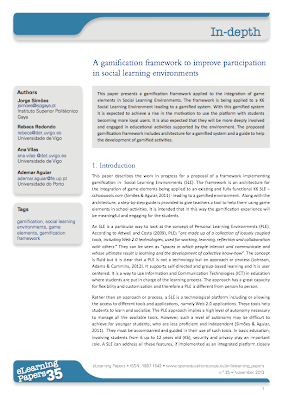
This paper presents a gamification framework applied to the integration of game elements in Social Learning Environments. The framework is being applied to a K6 Social Learning Environment leading to a gamified system. With this gamified system it is expected to achieve a rise in the motivation to use the platform with students becoming more loyal users. It is also expected that they will be more deeply involved and engaged in educational activities supported by the environment. The proposed gamification framework includes architecture for a gamified system and a guide to help the development of gamified activities.

The K6 Social Learning Environment is Schoooools.com.

Thursday, January 16, 2014

Gamification for Information Retrieval (GamifIR’14) Workshop

(received by email from gamification-research@googlegroups.com)

Gamification for Information Retrieval (GamifIR’14) Workshop, held in conjunction with ECIR 2014
, Amsterdam, Netherlands
13 April 2014


Gamification is the application of game mechanics, such as leader boards, badges or achievement points, in non-gaming environments with the aim to increase user engagement, data quality or cost effectiveness.  A core aspect of gamification solutions is to infuse intrinsic motivations to participate by leveraging people’s natural desires for achievement and competition. While gamification, on the one hand, is emerging as the next big thing in industry, e.g., an effective way to generate business, on the other hand, it is also becoming a major research area. However, its adoption in Information Retrieval (IR) is still in its infancy,  despite the wide ranging IR tasks that may benefit from gamification techniques. These include the manual annotation of documents for IR evaluation, the participation in user studies to study interactive IR challenges, or the shift from single-user search to social search, just to mention a few.

This workshop focuses on the challenges and opportunities that gamification can present for the IR community. The workshop aims to bring together researchers and practitioners from a wide range of areas including game design, information retrieval, human-computer interaction, computer games, and natural language processing.


Call for papers: deadline 5 February 2014

Keynote by Prof. Richard Bartle, known for his 1996 Player Types model (see this post)

Topics include but are not limited to:
  • Gamification approaches in a variety of information-seeking contexts
  • User engagement and motivational factors of gamification
  • Player types, contests, cooperative games
  • Challenges and opportunities of applying gamification in IR
  • Gamification design and game mechanics
  • Game based work and crowdsourcing
  • Applications and prototypes
  • Evaluation of gamification techniques

Monday, December 16, 2013

eMOOCs 2014: Call for Papers

An invitation from the EMOOCs 2014 Team for the EMOOCs 2014 Summit, in Lausanne, Switzerland, on Feb 10-12, 2014:

"Dear Sir/Madam,

Have you heard of the recent global phenomenon that is revolutionizing education?

Massive Open Online Courses (MOOCs) have the potential to disrupt the higher education system. Did you know, for instance, that the number of MOOCs in Europe has more than tripled since the beginning of 2013? Do you want to learn about the opportunities that MOOCs can bring to your sector? How to plan, produce and run a MOOC?

We invite you to join the EMOOCs 2014 Summit of researchers, policymakers, and practitioners from the world of MOOCs in Lausanne, Switzerland, on Feb 10-12, 2014, to discuss the latest developments and find areas of common interest. EMOOCSs 2014 offers a series of workshops, meetings and the tutorial “All you need to know about MOOCs”.

With the input and participation of active MOOC stakeholders such as yourself, we intend to collectively shape the future of higher education in Europe.

Learn more about the programme and register for this unique event. The deadline for registration is the 1st of February 2014.

Feel free to contact us if you would like to receive any additional information. 

Sincerely yours,

The EMOOCs 2014 Team
"

http://www.emoocs2014.eu/


Important Dates
  • Submissions deadline:  October 4, 2013
  • Notification of acceptance: November 15, 2013
  • Camera ready papers due: January 5, 2014
An interesting view about how europe is dealing with MOOCs can be seen in this page from Open Education Europe with a distribution of MOOCs per country:

http://openeducationeuropa.eu/en/european_scoreboard_moocs


Spain is clearly on the lead with 129 MOOCs followed by the UK (69), France (48) and Germany (47).


Friday, November 22, 2013

Paper in the Special Issue of eLearning Papers on PLE

I have a new paper on my proposal for a gamification framework. It was published on november, 19, in the Special Issue of eLearning Papers on Personal Learning Environments (issue nº 35). The paper is co-authored with Rebeca Redondo (University of Vigo), Ana Vilas (University of Vigo) and Ademar Aguiar (University of Porto).

The paper, A gamification framework to improve participation in social learning environments, describes a gamification framework applied to the integration of game elements in Social Learning Environments. The framework is being applied in Schoooools.com, a Social Learning Environment for K6.
https://www.academia.edu/4793907/A_Gamification_Framework_to_Improve_Participation_in_Social_Learning_Environments
This paper presents a gamification framework applied to the integration of game elements in Social Learning Environments. The framework is being applied to a K6 Social Learning Environment leading to a gamified system. With this gamified system it is expected to achieve a raise in the motivation to use the platform with students becoming more loyal users. It is also expected that they will be deeper involved and engaged in educational activities supported by the environment. The proposed gamification framework includes architecture for a gamified system and a guide to help the development of gamified activities.

See also this post - PLE and Smart Cities - from Ilona Buchem, one of the guest editors of this special issue of eLearning Papers.