Showing posts with label eLearning Papers. Show all posts

Monday, August 03, 2015

An Experiment to Assess Students’ Engagement in a Gamified Social Learning Environment

New paper published in issue 43 of eLearningPapers - Applied Games and Gamification – Drivers for Change:


An Experiment to Assess Students’ Engagement in a Gamified Social Learning Environment 

This paper presents a research work conducted to address students’ disengagement by investigating if gamification can make a contribution to solving this problem. The disposition to experience flow, a psychological state, was used as a measurement of engagement. An experiment allowed testing a research hypothesis concerning flow in a gamified environment.

co-authored with Sérgio Mateus, Rebeca Redondo a Ana Vilas.

The overall purpose of the experiment was to test the hypothesis that a gamified version of a Social Learning Environment (SLE) causes in its users an increase in their disposition to experience flow (see this other post) than the non-gamified version. The disposition to experience flow was assessed by using a questionnaire based on the Portuguese version of the DFS-2.

The experiment tested a group of subjects (a class of 3rd grade students) before and after the treatment (using the gamified version of the SLE). A pre-test, using the DFS-2, indicated how the subjects did prior to administration of the treatment condition and a post-test evaluated the subjects after the treatment. The effect was taken as the difference between the pre-test and the post-test scores.

Although small, an increase in the students’ tendency to experience flow was observed, particularly in the flow dimensions related to flow outcomes.

Issue 43 of eLearning Papers has two other gamification papers:

To Game or not to Game – a pilot study on the use of gamification for team allocation in entrepreneurship education 

and

What really works in gamification? Short answer: we don’t know, so let’s start thinking like experimenters

Monday, January 20, 2014

Open Education Europa: Best of 2013

Open Education Europa: top content of 2013 based on the number of pageviews


In the  category "Top articles from the eLearningPapers", my paper A gamification framework to improve participation in social learning environments, co-authored with Rebeca Díaz Redondo, Ana Fernandez Vlas (University of Vigo) and Ademar Aguiar (University of Porto) is #3. In second, another paper from University of Porto.


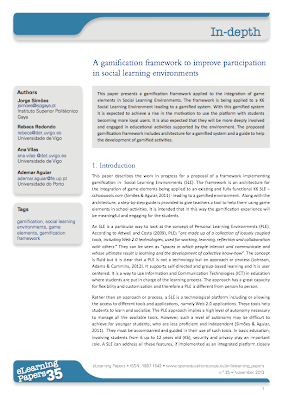
This paper presents a gamification framework applied to the integration of game elements in Social Learning Environments. The framework is being applied to a K6 Social Learning Environment leading to a gamified system. With this gamified system it is expected to achieve a rise in the motivation to use the platform with students becoming more loyal users. It is also expected that they will be more deeply involved and engaged in educational activities supported by the environment. The proposed gamification framework includes architecture for a gamified system and a guide to help the development of gamified activities.

The K6 Social Learning Environment is Schoooools.com.

Friday, November 22, 2013

Paper in the Special Issue of eLearning Papers on PLE

I have a new paper on my proposal for a gamification framework. It was published on november, 19, in the Special Issue of eLearning Papers on Personal Learning Environments (issue nº 35). The paper is co-authored with Rebeca Redondo (University of Vigo), Ana Vilas (University of Vigo) and Ademar Aguiar (University of Porto).

The paper, A gamification framework to improve participation in social learning environments, describes a gamification framework applied to the integration of game elements in Social Learning Environments. The framework is being applied in Schoooools.com, a Social Learning Environment for K6.
https://www.academia.edu/4793907/A_Gamification_Framework_to_Improve_Participation_in_Social_Learning_Environments
This paper presents a gamification framework applied to the integration of game elements in Social Learning Environments. The framework is being applied to a K6 Social Learning Environment leading to a gamified system. With this gamified system it is expected to achieve a raise in the motivation to use the platform with students becoming more loyal users. It is also expected that they will be deeper involved and engaged in educational activities supported by the environment. The proposed gamification framework includes architecture for a gamified system and a guide to help the development of gamified activities.

See also this post - PLE and Smart Cities - from Ilona Buchem, one of the guest editors of this special issue of eLearning Papers.

Saturday, April 06, 2013