Tuesday, April 29, 2014

EUTIC - European and interdisciplinary research network on issues and uses of information and communication technologies is pleased to announce its X Symposium - The role of ICT in the design of informational and cognitive processes, to be held in October 22-24, 2014, at Universidade NOVA de Lisboa, Portugal. 


Themes:
  • Scenarios for digital learning;
  • Information and communication science and technology;
  • Political and institutional communication;
  • Publishing and dissemination of information;
  • Culture promotion and heritage preservation;
  • Management and organisational strategies in the professional world;  
  • Employment and social inclusion;
  • Environmental protection and nature conservation.

Important Dates:
  • Call for papers - 7th March 2014 (extended to 12th May 2014)
  • EUTIC 2014 LISBON - 22, 23, 24th October 2014


Tuesday, April 22, 2014

CSEDU 2015: Call for Papers


CSEDU 2015, the International Conference on Computer Supported Education, aims at becoming a yearly meeting place for presenting and discussing new educational environments, best practices and case studies on innovative technology-based learning strategies, institutional policies on computer supported education including open and distance education, using computers. In particular, the Web is currently a preferred medium for distance learning and the learning practice in this context is usually referred to as e-learning. CSEDU 2014 is expected to give an overview of the state of the art as well as upcoming trends, and to promote discussion about the pedagogical potential of new learning and educational technologies in the academic and corporate world.

Conference Areas:
  • Information Technologies Supporting Learning 
  • Learning/Teaching Methodologies and Assessment 
  • Social Context and Learning Environments 
  • Domain Applications and Case Studies 
  • Ubiquitous Learning
Upcoming Deadlines:
  • Regular Paper Submission: December 16, 2014
  • Regular Paper Authors Notification: March 11, 2015
  • Regular Paper Camera Ready and Registration: March 25, 2015

Wednesday, April 16, 2014

Vote for the Top 100 Tools for Learning 2014

Vote for the Top 100 Tools for Learning 2014 until Friday 26 September 2014. The list will be revealed on Monday, 29 September 2014. It is possible to vote through the c4lpt website or by tweeting to @C4LPT. Voters much choose 10 tools for learning.

My vote in 2013 and my vote for 2014:


Small differences regarding the choices in 2013. I still vote for Classdojo, the only gamified tool in my list.

Last year's list is available at The Top 100 Tools for Learning 2013 (#1 Twitter, #2 Google Drive, #3 Youtube). 

Friday, April 11, 2014

A Brief History of Gamification: Part V - The Definitions (Again)

This is not exactly history (yet) but the discussion about the recent proposal for a gamification definition proposed by Brian Burke, a research analyst at Gartner, brings new issues that will help to understand the concept of gamification and, therefore, will probably be part of its history.


Gamification is “the use of game mechanics and experience design to digitally engage and motivate people to achieve their goals”

They care to explain in detail the components of their proposal:
  • Game mechanics describes the use of elements such as points, badges and leaderboards that are common to many games.
  • Experience design describes the journey players take with elements such as game play, play space and story line.
  • Gamification is a method to digitally engage, rather than personally engage, meaning that players interact with computers, smartphones, wearable monitors or other digital devices, rather than engaging with a person.
  • The goal of gamification is to motivate people to change behaviors or develop skills, or to drive innovation.
  • Gamification focuses on enabling players to achieve their goals. When organizational goals are aligned with player goals, the organization achieves its goals as a consequence of players achieving their goals.
Concerning game elements, not much to say. The examples given are the usual game elements found in gamified applications. Calling them game mechanics or game elements is another issue. I prefer the term "game elements". "Mechanics", in my view, are related to the rules that govern the use of the elements, how are they related and how they can motivate people to achieve their goals.

Experience design is, to my knowledge, a new term in the gamification universe. I believe it is related to the player journey (see this post). In the explanation there is a connection to play, which is a central component in gamification.

A major issue concerning the definition, that raises most of the discussion, is about "digitally engage". In this definition, gamification can only be applied in a digital context. That is not the view of many gamification researchers and practitioners (or gamification gurus). In fact, the concept can be used in any context, digital or non-digital. Digital technologies can help by providing the platforms to assist the implementation of the concept in a non-digital context, but that is not mandatory. See this post about the different application contexts of gamification.

The last part of the definition, motivate people to achieve their goals, is interesting since it focus on the players (the people with goals to be achieved) and not on the organizational goals (that must be aligned with the players' goals). But, in many situations, the target users of a gamified application, may not have such clear goals. In these cases, the gamified application tries to change the players behaviors, to achieve certain goals, that are useful for them but that they are not aware of (or concerned about). Therefore, the goals are set by the organization, and the gamified application tries to motivate the players to reach those goals, that must be clear for the players and that must be, ultimately, the players' own goals. This is particular relevant in educational contexts.

To summarize, this new definition and the discussion about it shows that there is still work to be done to clarify what is meant by gamification. It is now clear that is not the same of games or serious games or simulations or game-based learning (as it was initially confused). But the Burke/Gartner definition reveals that we must look deeper into the contexts where gamification can be applied and to the tools that can be used.

The most common definition, and widely used in the academia, is still "the use of game design elements in non-game contexts". Simple and straightforward. My own definition adds a second part:


It points to the goals of gamification, an engagement like the one people experience with games, as a way to promote some desired behaviors in the target users of the gamified application (that can be digital or non-digital).

Concerning the discussion about the Burke/Gartner definition, see this posts and discussions

Gartner Redefines Gamification: What Do You Think?

A response to Gartner’s new definition of gamification

What gamification is to me – My definition

Gartner is Soooooo Wrong about Gamification…

How #Gartner got Gamification Wrong


This is the fifth post of the series A Brief History of Gamification. See also,

A Brief History of Gamification: Part I - The Origin

A Brief History of Gamification: Part II - The Name

A Brief History of Gamification: Part III - The Definitions

A Brief History of Gamification: Part IV - The Evolution

Friday, April 04, 2014

A Brief History of Gamification: Part IV - The Evolution

This is the fourth post on The Brief History of Gamification, following Part I - The Origin, Part II - The Name and Part III - The Definitions. I invite others to contribute (with comments to the post) if something is missing and to correct what may be wrong or incomplete.

Since the first uses of the word gamification in late 2010, the concept quickly spread. That is due, in great part, to some popular video presentations, even if some of them do not use the word gamification. These video presentations, some at the TED Conferences, highlighted the importance of game thinking, with perspectives from game designers like Tom Chatfield, Jane McGonigal and Jessie Schell (all in 2010) or perspectives from digital marketing professionals, like Gabe Zichermann (in 2011).

In 2011, the word gamification was part of the Oxford University Press short list for the word of the year. In the same year, Jane McGonigal published Reality is Broken: Why Games Make Us Better and How They Can Change the World, a book about how features from video games could be used in different contexts making a contribution to a better citizenship and to a better world. Although McGonigal, a game designer, never mentioned the word gamification, the concept was present and inspired several other gamification’s developers and researchers. Many software applications, digital services, campaigns, products and communication strategies released in 2011 and after were inspired by this gamification movement.

Gartner added gamification to its “hype cycle for emergent technologies” in 2011, pointing for a period of 5 to 10 years for mainstream adoption. Gartner uses hype cycles to track technology adoption: after the “peak of inflated expectations” period, technologies will fall into the “trough of disillusionment”. Then, they will start evolving to the “slope of enlightenment” and some of them will reach the “plateau of productivity”. By 2013, gamification was at the “peak of inflated expectations”. 


Gamification became a buzzword in the business world and a popular term in digital media.

Also with an increasing number of scholars and professionals becoming interested in the concept, along with the general public, the online learning platform Coursera launched in August 2012, a MOOC on gamification, lectured by Kevin Werbach, an Associate Professor from the University of Pennsylvania. The course had more than 80.000 registered students with further editions in 2013 (with 66.000 students) and January 2014 (with 70.000 registrations). After the first edition of the course, Werbach co-authored the book For the Win: How Game Thinking Can Revolutionize Your Business.

Since 2011, a large number of web log posts were released covering gamification related themes. These first references to gamification were very informal and debated the advantages or drawbacks of the concept and look for examples within web applications. Books on gamification were also published (e.g. Gamification by Design, Gamification at Work: Designing Engaging Business SoftwareLoyalty 3.0: How to Revolutionize Customer and Employee Engagement with Big Data and Gamification). Most of them approach the concept with a business or enterprise view and others cover specific areas of application, like education and training (The Gamification of Learning and Instruction: Game-based Methods and Strategies for Training and Education; The Gamification of Learning and Instruction Fieldbook: Ideas into Pratice).

Gamified applications, gamification platforms and a large number of academic papers on gamification also became part of the gamification movement, but that is for future posts.

The concept behind gamification long precedes the emergence of the term although its spread was only possible when the digital games industry has matured and after a generation of gamers was fully active in their working lives. The proliferation of digital media, social networks and other popular Web 2.0 applications have also created the environment that helped the dissemination of a movement that, despite all the criticism, became known as gamification.

This nice infographic (first published here) shows some of the important milestones on the short but rich history of gamification:


http://technologyadvice.com/gamification/blog/history-of-gamification-infographic/

See also:

A Brief History of Gamification: Part I - The Origin

A Brief History of Gamification: Part II - The Name

A Brief History of Gamification: Part III - The Definitions 

Thursday, March 27, 2014

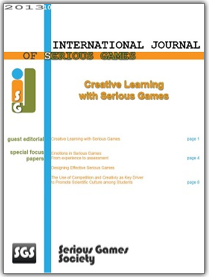
IJSG - International Journal of Serious Games

The International Journal of Serious Games (IJSG) has lauched its first issue (volume 1, number 1, january 2014). The published papers are fully available for download:


Individual and collaborative Performance and Level of Certainty in MetaVals
Mireia Usart, Margarida Romero

Gamification and Smart, Competence-Centered Feedback: Promising Experiences in the Classroom
Michael D. Kickmeier-Rust, Eva C. Hillemann, Dietrich Albert

Guidelines for an effective design of serious games
Chiara Eva Catalano, Angelo Marco Luccini, Michela Mortara

Serious Games for education and training
Alessandro De Gloria, Francesco Bellotti, Riccardo Berta

Business models for Serious Games developers - transition from a product centric to a service centric approach
Jannicke Baalsrud Hauge, Stefan Wiesner, Rosa Garcia Sanchez, Poul Kyvsgaard Hansen, Giusy Fiucci, Michel Rudnianski, Jon Arambarri Basanez

The journal is seeking for contributions in several topics. Gamification is one of those topics.

The IJSG is published by the Serious Games Society.

Wednesday, March 26, 2014

A Brief History of Gamification: Part III - The Definitions

The third part of The Brief History of Gamification is here, following A Brief History of Gamification: Part I - The Origin and A Brief History of Gamification: Part II - The Name. I invite others to contribute (with comments to the post) if something is missing and to correct what may be wrong or incomplete.

This third post is about the definition of the concept that became known as gamification. There are probably as many definitions for gamification as people writing about it. Gamification definitions have been proposed since the word appeared in 2010. Some of them were listed previously in this blog in a post where 23 definitions were listed. Those definitions were found in web logs, technical reports and academic papers. Some of them are redundant or very similar to each other. 

Here are some of those definitions and a few more recent ones:
  • “The notion that gaming mechanics can be applied to routine activities” (Johnson et al., 2014);
  •  “The use of game mechanics and rewards in non-game setting to increase user engagement and drive desired user behaviors” (Duggan and Shoup, 2013);
  • “Implementing design concepts from games, loyalty programs, and behavior economics to drive user engagement” (Zichermann and Linder, 2013);
  • “The use of game elements and game-design techniques in non-game contexts” (Werbach and Hunter, 2012);
  •  “The application of game metaphors to real life tasks to influence behaviour, improve motivation and enhance engagement” (Marczewski, 2012); 
  • “Using game techniques to make activities more engaging and fun” (Kim, 2011); 
  • “The use of game attributes to drive game-like player behavior in a non-game 
context” (Wu, 2011); 
  • “Taking game mechanics and applying to other web properties to increase engagement” (Terrill, 2008);

     
Other definitions from the academia are:
  •  “Incorporating game elements into a non-gaming software application to increase user experience and engagement” (Domínguez et al., 2013);
  • “A form of service packaging where a core service is enhanced by a rules-based service system that provides feedback and interaction mechanisms to the user with an aim to facilitate and support the users’ overall value creation” (Huotari and Hamari, 2011);
  • “The use of game mechanics, dynamics, and frameworks to promote desired behaviors” (Lee and Hammer, 2011);
  • “The use of game design elements in non-game contexts” (Deterding et al., 2011).
This shows that there is no consensus for a single and widely accepted definition for gamification (Werbach and Hunter, 2012). The first known definition in an academic paper is the one from Huotari and Hamari. In spite of all these different proposals, the definition that is more often found in academic papers is the one from Deterding et al. (2011). This definition is now widely used as the academic definition for the concept of gamification.

The definition from Domínguez et al. refers to non-gaming educative contexts. To conclude, some more definitions regardind education and training contexts:
  • “The adition of elements commonly associated with games (e.g. game mechanics) to an educational or training program in order to make the learning process more engaging” (Landers and Callan, 2011); 
  • “Using game-based mechanics, aesthetics and game thinking to engage people, motivate action, promote learning, and solve problems” (Kapp, 2012); 
  • “Simple gameplay to support productive interaction for expected types of learners and instructors” (Rughinis, 2013); 

See also:

A Brief History of Gamification: Part I - The Origin

A Brief History of Gamification: Part II - The Name

References:
Deterding, S., Dixon, D., Khaled, R., and Nacke, L. (2011). From game design elements to gamefulness: Defining ”gamification". In Proceedings of the 15th International Academic MindTrek Conference: Envisioning Future Media Environments, MindTrek ’11, pages 9–15, New York, NY, USA. ACM.
 Domínguez, A., Saenz-de Navarrete, J., de Marcos, L., Fernández-Sanz, L., Pagés, C., and Martínez-Herráiz, J. (2013). Gamifying learning experiences: Practical implications and outcomes. Computers and Education, 63(0):380–392. 
Duggan, C. and Shoup, K. (2013). Business Gamification for Dummies. John Wiley and Sons, Inc.  
Johnson, L., Adams Becker, S., Estrada, V., and Freeman, A. (2014). NMC Horizon Report: 2014 Higher Education Edition. Technical report, Austin, Texas: The New Media Consortium. 
Huotari, K. and Hamari, J. (2011). Gamification: from the perspective of service marketing. In Proc. CHI 2011 Workshop Gamification. 
Landers, R. and Callan, R. (2011). Casual social games as serious games: The psychology of gamification in undergraduate education and employee training. Serious Games and Edutainment Applications.
Lee, J. and Hammer, J. (2011). Gamification in education: What, how, why bother? Academic Exchange Quarterly, 15(2):2.
Marczewski, A. (2012). Gamification: A Simple Introduction. Marczewski, A.
Rughinis, R. (2013). Gamification for productive interaction reading and working with the gamification debate in education. In Proceedings of the Information Systems and Technologies (CISTI), 8th Iberian Conference on Information Systems and Technologies.
Terrill, B. (2008). My coverage of lobby of the social gaming summit   
Werbach, K. and Hunter, D. (2012). For the Win: How Game Thinking Can Revolutionize Your Business. Wharton Digital Press. 
Wu, M. (2011). What is gamification, really? [web log message] 
Zichermann, G. and Linder, J. (2013). The Gamification Revolution. McGraw-Hill Education. 

Friday, March 21, 2014

gEducation Workshop: Call for Papers

The gEducation Workshop - How Gamification is changing the future of Education will be held in Barcelona, on the Gamification World Congress. The gEducation Workshop will be on Saturday, May 24, 2014 (9:00am - 1:30pm).  

Topics of Interest:

    •    Tools for education
    •    Gamification in education
    •    Techniques and strategies
    •    Frameworks
    •    Collaborative learning
    •    Innovative methodologies
    •    Success stories
    •    User experiences and gamification in the clasrooms
    •    Management of gamified classrooms
    •    Useful resources for educators
    •    Gamification for different learning levels
    •    Styles of gamfication in educational environment
    •    E-learning

Important Dates:

    •    Submission deadline: April 14
    •    Notifications: May 1
    •    Workshop: May 24

http://www.gamificationworldcongress.com/

Friday, March 14, 2014

A Brief History of Gamification: Part II - The Name

This is the second post regarding the origin and evolution of gamification, following A Brief History of Gamification: Part I - The Origin. I invite others to contribute (with comments to the post) if something is missing and to correct what may be wrong or incomplete.

The Name

About the concept’s name, several authors claim that the term gamification, a neologism, was created in 2002 (Marczewski, 2012; Penenberg, 2013), or 2003 (Werbach and Hunter, 2012), or 2004 (Rughinis 2013) by Nick Pelling, a British programmer and video game designer. In fact, according to this alleged author, the word was created in 2002 (Pelling, 2011) and became public in 2003 in Pelling’s company website. By then, he intended to apply his gamification ideas to electronic devices. Others claim the term’s authorship for themselves at even earlier dates: “a trend I call gameification, which I first identified in the early eighties” (Burrus and Mann, 2012). Other sources indicate that the term was invented by Tim Chang from Norwest Venture Partners at an undefined date.

In digital media and according to Huotari and Hamari (2012), the term, written as gameification, was mentioned for the first time in 2008 in a blog post (Terrill, 2008). Werbach and Hunter (2012) note also that it was only in 2010 that the term was widely adopted. In fact, the term only started to be searched in Google on August, 2010 (Duggan and Shoup, 2013; Zichermann and Linder, 2013).


Before the term gamification came into widespread use on digital media, the underlying concept was also known as funware, a term proposed by Gabe Zichermann. Similar terms were associated with the concept like fun at work, serious games or games with a purpose (Rughinis, 2013), although these last two terms are in fact related with different concepts. Landers and Callan (2011) also use the term gameification, applying it in learning contexts. Besides all of these alternative terms, the word gamification prevailed even not being consensual.

The concept is seen by many as misleading and difficult to define (Anderson and Rainie, 2012; Raczkowski, 2013) and as Robertson (2010) claims “is the wrong word for the right idea”. Although game design is central to the concept of gamification, some game designers do not agree neither with the word nor with the concept (e.g. Bogost, 2011a). As long as the word became popular, criticism of gamification also made presence in digital media. Some game designers point that gamification is just a meaningless buzzword. Depreciative terms like exploitationware (Bogost, 2011b) or pointsification as proposed by Robertson, shows that both the word and the concept are not consensual.

See also:

A Brief History of Gamification: Part I - The Origin

A brief history of gamification, by Zac Fitz-Walter

Who coined the term gamification?

References:

Anderson, A. and Rainie, L. (2012). The future of gamification. Technical report, Pew Research Center’s Internet and American Life Project. 

Duggan, C. and Shoup, K. (2013). Business Gamification for Dummies. John Wiley and Sons, Inc.
 
Burrus, D. and Mann, J. (2012). Gameification: Accelerating learning with technolog

Bogost, I. (2011a). Gamification is bullshit

Huotari, K. and Hamari, J. (2012). Defining gamification: A service marketing per- spective. In Proceeding of the 16th International Academic MindTrek Conference, MindTrek ’12, pages 17–22, New York, NY, USA. ACM.
 
Landers, R. and Callan, R. (2011). Casual social games as serious games: The psychology of gamification in undergraduate education and employee training. Serious Games and Edutainment Applications.
 
Marczewski, A. (2012). Gamification: A Simple Introduction. Marczewski, A.  

Pelling, N. (2011). The (short) prehistory of “gamification”

Penenberg, A. (2013). Play at Work: How Games Inspire Breakthrough Thinking. Piatkus. 

Robertson, M. (2010). Can’t play, won’t play

Raczkowski, F. (2013). It’s all fun and games... a history of ideas concerning gamification. In Proceedings of DiGRA 2013: DeFragging Game Studies.

Rughinis, R. (2013). Gamification for productive interaction reading and working with the gamification debate in education. In Proceedings of the Information Systems and Technologies (CISTI), 8th Iberian Conference on Information Systems and Technologies.

Terrill, B. (2008). My coverage of lobby of the social gaming summit

Werbach, K. and Hunter, D. (2012). For the Win: How Game Thinking Can Revolutionize Your Business. Wharton Digital Press. 

Zichermann, G. and Linder, J. (2013). The Gamification Revolution. McGraw-Hill Education.

Friday, March 07, 2014

A Brief History of Gamification: Part I - The Origin

This is the first post regarding the origin and evolution of gamification, the concept broadly defined as "the use of game elements in non-game contexts". I invite others to contribute (with comments to the post) if something is missing and to correct what may be wrong or incomplete.


The Origin

The concept behind what become known as gamification in recent years was already known almost one hundred years ago. Nelson (2012) argue that the origins of gamification are in the early to mid 20th century in Soviet Union, like “a way to motivate workers without relying on capitalist-style monetary incentives”. Workers and factories could compete with each other to increase production, using points and other game-like elements. Later, in american management, on the transition from the 20th to the 21st century, the strategy of turning the workplace into a more playful setting reappeared. In 1984, Coonradt (2007) published the first edition of his book The Game of Work. Coonradt, known as the “grandfather of gamification”, applied game principles in business contexts, dealing with employee motivation. His principles to motivate people include frequent feedback, clear goals and personal choice, features that can be found in games. These American and Soviet approaches, as precursors of gamification, gave rise to o sub-genre of the concept, the “gamification of work” (or playbour). Even before Coonradt's work, loyalty programs, like frequent flyer programs in airline companies (Kumar and Herger, 2013), where travelers gain miles (i.e. points) that can be exchanged for some benefit, and other marketing campaigns already incorporate some game features.

In other contexts, similarities with game elements can be found in the use of icons or symbols to express achievements, as insignias on military uniforms or insignias used on youth organizations like the Scouts (Silvers, 2011; Werbach and Hunter, 2012). These icons and symbols have their digital counterpart in video games’ badges (Rosewell, 2012). As the Scout can collect badges and display them on their uniform, digital badges can be used to display individual skills, abilities and accomplishments since a software system provides the adequate infrastructure.

In the Information and Communication Technologies (ICT) context, Deterding et al. (2011) note that, in the 1980s, in Human-Computer Interaction (HCI), the design of user interfaces already benefited from the knowledge of different design practices, namely game design. Playfulness, as a desirable user experience or mode of interaction, gained the attention of multiple HCI researchers. As Deterding et al. refer, game elements were long used in HCI, as game controllers used as input devices or graphic engines and authoring tools of video games used in non-ludic contexts.
Game-Based Learning (GBL) and the Serious Games movement contribute to the spread of the concept, revealing that games could be useful in non-ludic contexts instead of just being used for fun and amusement. Gamification, connects to concepts related to HCI and to game studies, as serious games, pervasive games, alternate reality games, or playful design ( Deterding et al.).


References:
Nelson, M. (2012). Soviet and american precursors to the gamification of work. In Lugmayr, A., editor, MindTrek, pages 23–26. ACM.
Coonradt, C. (2007). The Game of Work: How to Enjoy Work as Much as Play. Gibbs Smith.
Kumar, J. and Herger, M. (2013). Gamification at Work: Designing Engaging Business Software. Aarhus, Denmark,. The Interaction Design Foundation.
Silvers, A. (2011). On education, badges and scouting [web log message].
Werbach, K. and Hunter, D. (2012). For the Win: How Game Thinking Can Revolutionize Your Business. Wharton Digital Press.
Rosewell, J. (2012). A speculation on the possible use of badges for learning at the uk open university. In EADTU Annual Conference: The Role Of Open And Flexible Education In European Higher Education Systems For 2020: New Models, New Markets, New Media.
 
Deterding, S., Dixon, D., Khaled, R., and Nacke, L. (2011). From game design elements to gamefulness: Defining ”gamification". In Proceedings of the 15th International Academic MindTrek Conference: Envisioning Future Media Environments, MindTrek ’11, pages 9–15, New York, NY, USA. ACM.